US Food Sovereignty Alliance

Category: Food Sovereignty

Contains all pages under the Food Sovereignty menu item.

  • “Food sovereignty is justice for farmer workers” – First Video of Food Sovereignty Stories Series

    “Food sovereignty is justice for farmer workers” – First Video of Food Sovereignty Stories Series

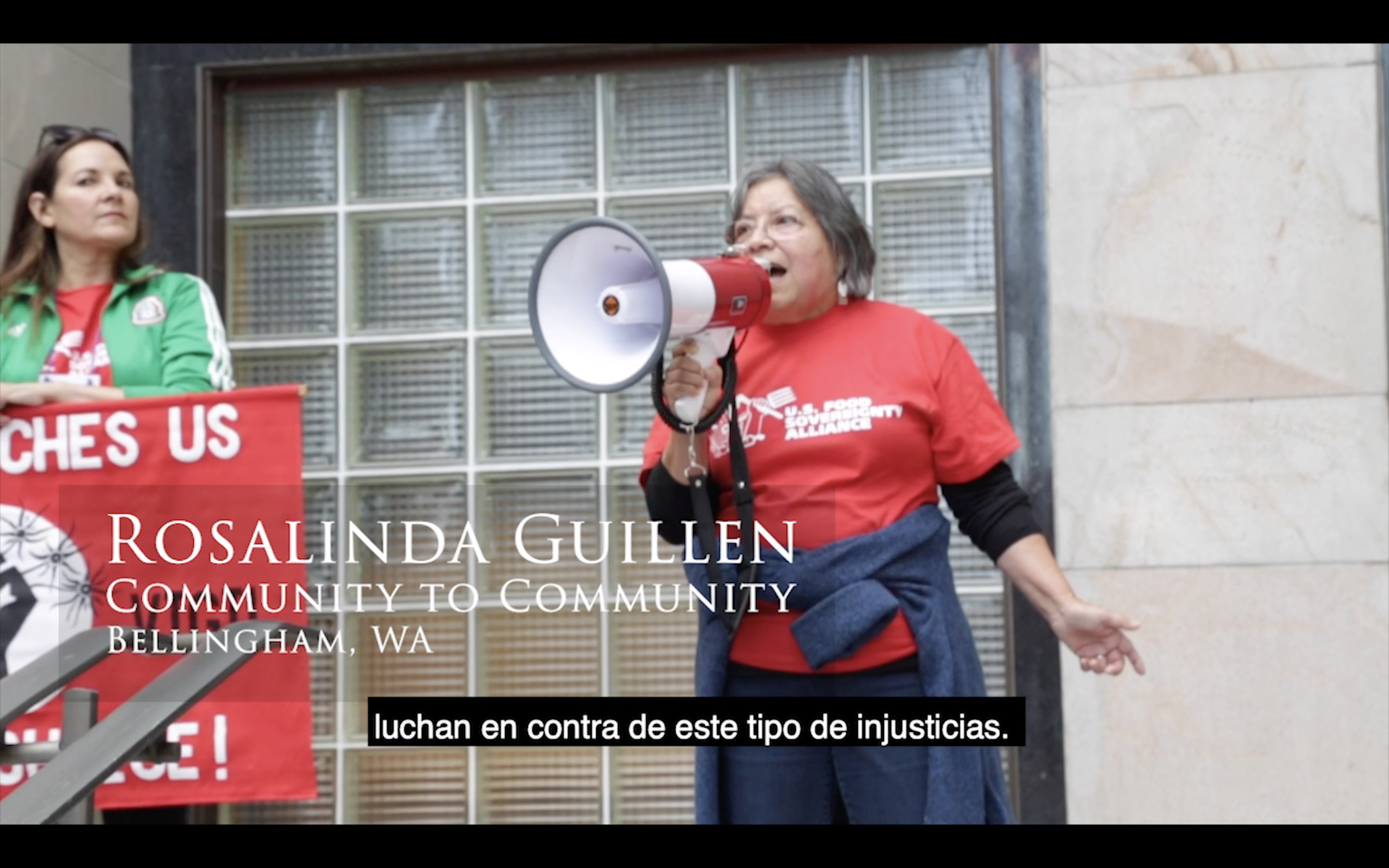
    Food Sovereignty Stories is a series of videos from social movements in the United States working towards a more just, sovereign, and sustainable food system. The first film focuses on food sovereignty and justice for farm workers.

    For Brenda Bentley, an organizer with Community to Community Development (C2C), a grassroots organization fighting for food justice and migrant justice in Bellingham, Washington, food sovereignty is inseparable from immigrant rights.

    “Food sovereignty in Bellingham for me has been trying to get a sanctuary ordinance for our undocumented community,” Brenda said outside Bellingham City Hall after a demonstration calling on lawmakers to act. “People don’t feel safe here.”

    When Brenda shared her thoughts in October 2018, C2C had been organizing weekly “Dignity Vigils” outside City Hall for more than a year and a half to call for protections for undocumented people against detention and deportation. The organization has worked closely with farmworkers over the years to fight for fair wages, safe working conditions, and increased self-determination for farmworkers.  

    Brenda stressed that food sovereignty must start at the foundation of the food system with justice for the farmworkers who plant, cultivate, and harvest food.

    “Food sovereignty for me, looking at it from that perspective, is people in the fields being comfortable to venture out to buy food, which they don’t. People feeling safe enough to come into town, which they don’t. People just being able to live without fear, to be able to afford the food that they grow, and they don’t,” she said. “A lot of our farmworkers at least in this county go to the food bank, and that’s disgusting.”

    “For me, food sovereignty is justice for farmworkers, fair wages, a pathway to citizenship, a reasonable life, a future for their children—all the things that we want for ourselves and our neighbors, for everyone,” she concluded.

    As C2C executive director Rosalinda Guillén put it, “everything circles around food,” and food sovereignty is part of “fighting for justice in every way that we know how.”

    Food Sovereignty Stories is a video series exploring what food sovereignty can look like for diverse social movements across the United States. Share this video and follow USFSA for updates!
  • Solidarity Letter to the Highlander Research and Education Center

    The US Food Sovereignty Alliance expresses our solidarity with those at the Highlander Research and Education Center after the recent racially-motivated arson attack. USFSA’s Political Education Collective drafted the letter, and the letter was ratified by the National Coordination of the US Food Sovereignty Alliance.

    To our friends and colleagues at the Highlander Research and Education Center:

    The US Food Sovereignty Alliance (USFSA), a national alliance of food justice, anti- hunger, labor, environmental, faith-based, and food producer groups sends this message of solidarity and concern to the current staff, board and constituents of the Tennessee-based Highlander Research and Education Center, at the news of the March 29, 2019 arson attack that destroyed the main office building. While we are thankful that no one was hurt or injured, we are distressed that a white supremacist symbol was found in the parking lot near where the arson took place and deeply saddened by the loss of six decades of archival material that chronicled the emergence of social movements, including the Civil Rights Movement.

    We recognize that much of our work as the US Food Sovereignty Alliance stands on the shoulders of movement organizers for union and worker rights, anti-racism, civil rights, social and economic justice, many of whom were the beneficiaries of education received at the Highlander Center, founded in 1932 by Myles Horton, Don West and James Dombrowski. We are grateful to be the beneficiaries today of the path that was laid to strengthen grassroots organizing and movement building despite acts of bigotry and hatred, and racially-motivated threats and attacks on the poor and working class which the Highlander Center resisted with popular education, language justice, participatory research and cultural work. By serving as a catalyst for communities to take collective action to shape their own destiny, the Highlander Center has persisted and triumphed for decades, from the time of the Great Depression, through Jim Crow, the Civil Rights Movement, and Appalachian economic justice struggles, and more recently struggles for democratization in solidarity with immigrants and other marginalized and scapegoated populations.

    As we seek to develop our own political education processes as a US-based alliance devoted to profound transformation of the economy, culture and political organizing around food and agriculture in the United States and linked to struggles for food sovereignty worldwide, we lift up and honor the long history of education and training that Highlander has been an epicenter for.

    As we stand in solidarity with the Highlander Center, we also stand firmly opposed to the rise of white supremacist groups and the ideology of fear-based bigotry and violent opposition to our movements for positive social change.

    Forever in solidarity! Globalize the Struggle, Globalize the Hope!

    Signed,

    The US Food Sovereignty Alliance

    To view the .pdf letter sent to Highlander Center, click here.


  • Reading Lists

    Food Crisis

    From Food Rebellions to Food Sovereignty: Urgent call to fix a broken food system

    By Eric Holt-Giménez, Ph.D., Social Scientist and Executive Director of Food
    First/Institute for Food and Development Policy. The real causes of the 2008 and 2011 food price crises were numerous, but the fact that our global agricultural system is dominated by corporations, free trade, and speculation was neglected by most media outlets.

    Harvesting Money – The Global Land Grab

    By Eric Holt-Giménez, Ph.D., Social Scientist and Executive Director of Food First/Institute for Food and Development Policy.The food and financial crises of 2008 ignited a massive round of “land grabbing” in the Global South, with foreign agribusinesses leasing and buying large tracts of land to produce both food and fuel crops for export.

    The World Food Crisis: What’s behind it and What we can do about it

    By Eric Holt-Giménez, Ph.D., Social Scientist and Executive Director of Food
    First/Institute for Food and Development Policy.


    Agroecology

    Can Sustainable Agriculture Feed the World?

    Sustainable Agriculture CAN feed the world, and it can protect the planet and end hunger and poverty.

    Agroecology and the Right to Food

    “The report therefore calls States for a fundamental shift towards agro-ecology as a way for countries to feed themselves while addressing climate and poverty challenges.”


    Food Sovereignty

    Declaration of Nyeleni

    “We, more than 500 representatives from more than 80 countries, of organizations of peasants/family farmers, artisanal fisherfolk, indigenous peoples, landless peoples, rural workers, migrants, pastoralists, forest communities, women, youth, consumers and environmental and urban movements have gathered together in the village of Nyéléni in Sélingué, Mali to strengthen a global movement for food sovereignty…”

    Food Sovereignty Booklet

    An accessible description of what food sovereignty is, who is affected, and why it is more important than ever. From the National Family Farm Coalition and Grassroots International.

    Food for Thought and Action: A Food Sovereignty Curriculum

    Our global food system is terribly broken. Together, we can fix it! In the Curriculum you will find modules, factsheets, and other materials to learn about food sovereignty from the perspectives of consumers, anti-hunger organizations, environmentalists, and Small Farmers and farmworkers.


    Theological

    The Daily Bread

    Short reflection on food sovereignty by Werner Fuchs, Lutheran pastor and translator, member of the CONSEA (National Council for Food Security of Brazil).

    Turning the Tables: People First

    One-page reflection on food sovereignty by Roberto Malvezzi, Pastoral Land Commission (Brazil).


    Corporate Control

    “Foodopoly”

    Watch the trailer to Foodopoly, the film and book from Wenonah Hauter of Food and Water Watch.

    The Urban and Northern Face of Global Land Grabs

    Taken from a presentation at the International Conference on Global Land Grabbing, Eric Holt-Gimenez of Food First and Annie Shattuck and Yi Wang explain how land grabs are affecting urban areas in the Global North, in addition to the rural land grabs in the Global South. This shared, universal threat requires immediate action and global solidarity

    Grabbing the Food Deserts: Large-scale land acquisitions and the expansion of retail monopolies

    Eric Holt-Gimenez, Annie Shattuck, and Yi Wang explain how food retail corporations are behind the urban and northern land grab in this Food First backgrounder.

    Anti-Racism

    The Color of Food

    From The Applied Research Center, “The Color of Food” reveals that racism and exploitation that exist in our food system and suggests ways to transform our food system into a vehicle of justice.

    Youth and Food Justice: Lessons from the Civil Rights Movement

    “Youth and Food Justice: Lessons from the Civil Rights Movement,” by Anim Steel Food First Backgrounder, 2010.

  • USFSA Assembly in Solidarity with US and International Struggles

    USFSA Assembly in Solidarity with US and International Struggles

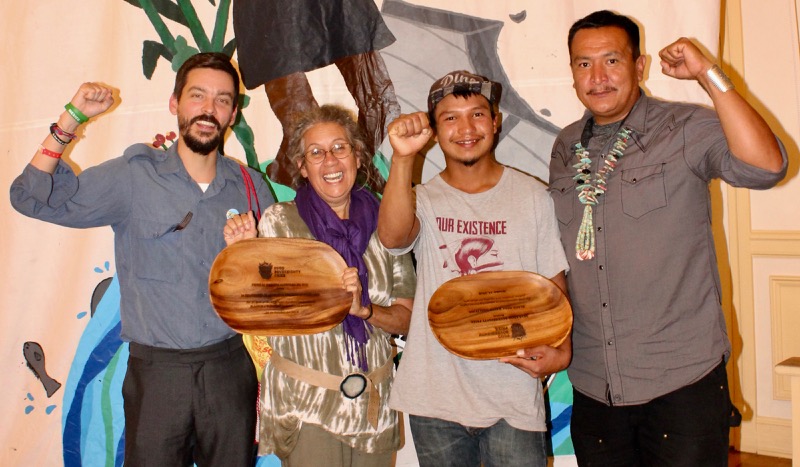
    The US Food Sovereignty Alliance (USFSA) held its IV National Assembly from October 12th thru 14th in Bellingham, Washington with the participation of 117 members, allies, and individuals from 71 organizations and 7 countries.  The theme “Defending Mother Earth for an Agroecological Life:  No Walls, No Capitalism” was enacted through art, drama, music, dance, organizing, debate, analysis, healthy locally-sourced food, and spirited “mística” ceremonies.

    Read and download the “Bellingham Declaration” in English or Spanish.